Inside a session
A complete chess lesson plan, ready to teach
This Explorer example shows session 115 of 213, “Three-Move Combinations”, in Bishop Stage. Review its lesson parts, positions, questions, activity and homework in the same views coaches use.
- 8lesson parts
- 60minutes planned
- 43minutes timed
- 8graded positions
- 6discussion questions
- 15minutes of homework
The Teach view during class
This screenshot shows session 115 on its first warm-up position in the teaching console.
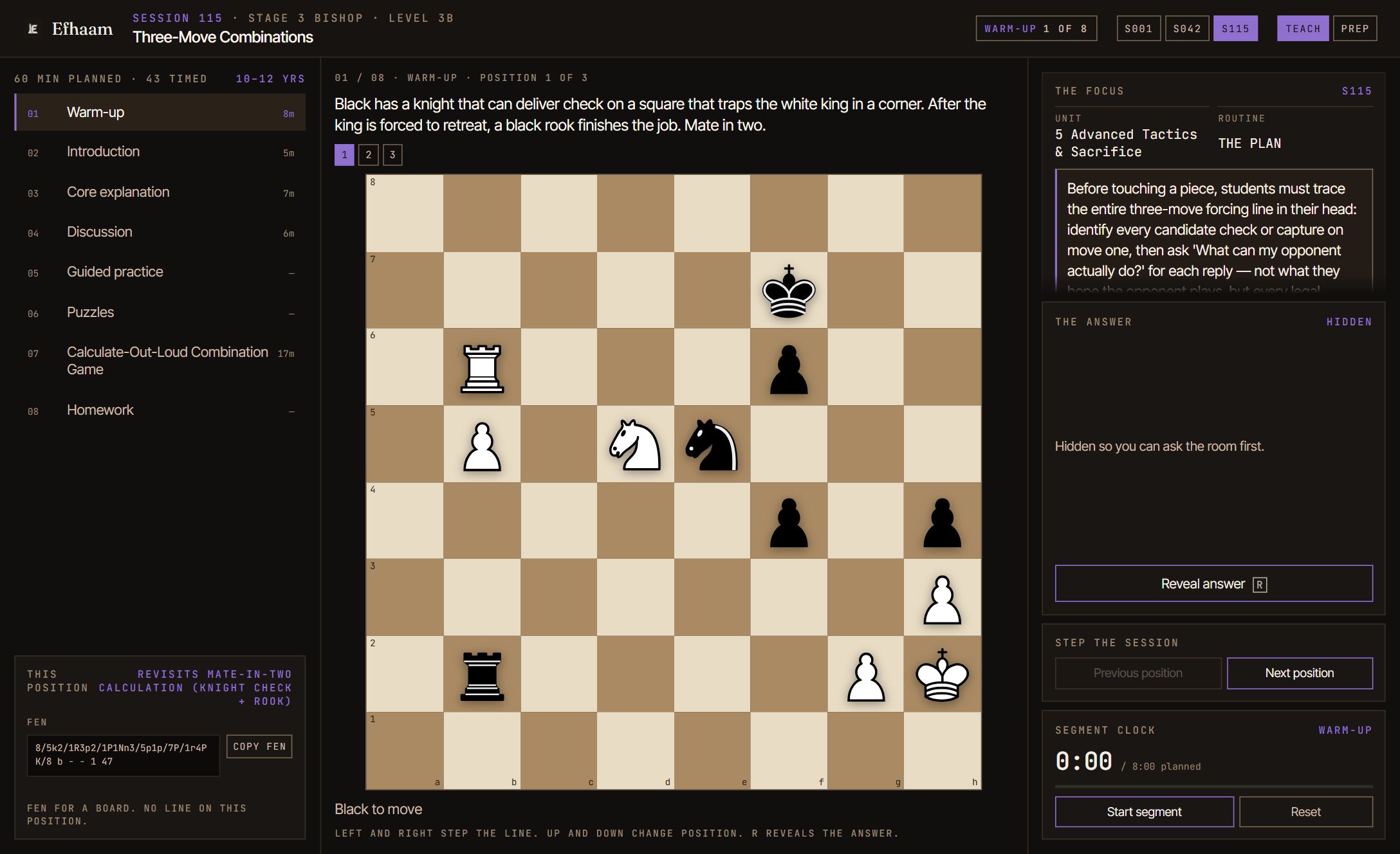
- 1
Session details
The screen shows the session number, stage, level and title, along with where the lesson sits in the curriculum sequence.
- 2
Prep and Teach views
Prep is the document to review before class. Teach is the console for presenting the same lesson to students.
- 3
Lesson outline
This session has eight parts. Select a part to jump to it in the lesson plan; the timed parts show their planned duration.
- 4
Board and position
The board shows a position from the session. Use the arrow keys to step through its solution line.
- 5
Lesson prompt
The session includes a prompt and a teaching note to guide the coach through this position.
- 6
Reveal the solution
Solutions stay hidden until the coach reveals them. The board then steps through the line one move at a time.
- 7
Timer for each timed part
The console shows the planned time for this part. Guided practice, puzzle work and homework do not have a fixed in-class timer.
- 8
Copy a board or game line
Copy a position as FEN or the full line as PGN to use on another board or teaching screen.
This lesson has eight parts
Most Teach64 sessions use the same eight-part outline. This example shows how the warm-up, explanation, discussion, practice, positions, activity and homework fit together.
-
01Warm-up
8 min
These three mate-in-two puzzles are a deliberate ramp: they let students re-activate the calculation habit — spotting a forcing move, then confirming the single forced reply leads to checkmate — before we extend that same chain by one more move today.
3 positions to re-open
-
02Introduction
5 min
You have already mastered the two-move combination — one forcing move, one forced reply, checkmate. Today we go one step deeper into the engine room of chess thinking: three-move forced combinations, where you must hold the entire forcing line in your mind before you touch a single piece. Welcome to Unit 5 — Advanced Tactics and Sacrifice.
-
03Core explanation
7 min
Calculating a forced three-move combination is the first time students must hold a branching mental picture across three plies of their own moves and two forced replies.
5 key points
-
04Discussion
6 min
Use these talking points to draw out students’ understanding of why forced combinations work and what separates a genuine three-move forced line from a sequence that merely looks promising.
5 talking points
-
05Guided practice
no clock
Worked examples the coach plays through with the room, each with the walkthrough written under it.
1 worked examples
-
06Puzzles
no clock
The graded positions, in order, each with its prompt, its answer and the mistakes students usually make on it.
8 graded positions
-
07Calculate-Out-Loud Combination Game
17 min
Students work in pairs at a shared board. The coach or a student sets up a puzzle position from the session (starting with P1–P2 Foundation positions).
4 instructions
-
08Homework
no clock
Set for home, not for the room, which is why it carries no minutes here and 15 at the kitchen table instead.
6 pieces of work
Three tournament-prep and game-analysis sessions use seven parts. The other sessions use eight.
60 minutes planned, 43 minutes timed
Five of the eight parts have an assigned time. Guided practice, puzzle work and homework do not have fixed in-class minutes.
Untimed parts give the coach room to adapt the lesson to the students in the group. The session still provides the material, order and graded positions.
The console shows the planned session length and timed minutes together.
Session 115 · where the 43 minutes go
- Warm-up 8m
- Introduction 5m
- Core explanation 7m
- Discussion 6m
- Calculate-Out-Loud Combination Game 17m
- Guided practice no clock
- Puzzles no clock
- Homework no clock
Minutes read off session 115 in curriculum bundle 1.2.0. Across Explorer a session runs 50 to 75 minutes, most of them 60.
Graded positions for this lesson
These 8 positions appear in session 115, each with a prompt and solution. 2 are Foundation, 3 Core and 3 Challenge positions.
mate in three · back-rank mate · rook ladder · forcing moves
mate in three · first-rank mate · rook ladder · forcing moves
mate in three · queen sacrifice · deflection · back-rank mate
mate in three · x-ray · battery · e-file
mate in three · deflection · queen sacrifice · first-rank mate
mate in three · corner mate · knight fork · rook
mate in three · deflection · pin · back-rank mate
mate in three · promotion · back-rank mate · forcing moves
Reveal the solution and step through the line
Each position includes its solution, full line, an explanation of the replies and common student mistakes. The coach can reveal the answer, then step through the line on the board.
Across Explorer: 1,640 positions, 557 Foundation, 646 Core and 437 Challenge. The puzzle checker validates position legality, side to move and solution lines.
900–1300 · stage 3
Discussion questions are included
Session 115 includes 6 prepared questions. The Explorer course has 1,247 questions to help coaches lead discussion.
These prompts allow students to explain and compare their answers, not only recall a fact.
Session 115 · teaching flow · questions to ask, verbatim
- Before you play move one of a three-move combination, what three things do you need to confirm about the final position to be sure it is checkmate?
- If your move one is a check, how do you decide which of the opponent’s king moves is the forced reply — and what if the king has two possible squares?
- What is the difference between a forcing move and a strong move, and why does that difference matter when you are calculating a combination?
- If you calculate a three-move line and find that move two does not force a reply, is the sequence still a forced combination? What should you do instead?
- Why do we say you must calculate to the END of the line before committing to move one — can you describe a situation where stopping the calculation one move early would lead you astray?
- In a combination where move one involves a sacrifice, why is it essential to know your opponent’s forced reply before you give up the piece?
Practical activity
Calculate-Out-Loud Combination Game takes 17 minutes and is designed for this session.
Students work in pairs at a shared board. The coach or a student sets up a puzzle position from the session (starting with P1–P2 Foundation positions). Before either player touches a piece, the solver must state the full three-move line out loud — ’I play this, you must play that, then I play this and it is checkmate’ — so their partner can listen for any gap in the calculation. Partners rotate solver and checker roles after each puzzle.
What counts as success: Both partners can state a complete, gapless three-move forcing line for at least three positions — correctly identifying why each opponent reply is forced — before executing a single move on the board.
213 activities are included across 213 Explorer sessions.
- 01
Set up the assigned puzzle position. The solver studies the board in silence for up to 90 seconds, identifying checks, captures, and forced replies — no piece is touched during calculation.
- 02
The solver speaks the full line aloud before moving: state move one, state the forced reply (and why it is the only option), state move two, state the forced reply, state move three, and confirm checkmate. Partner listens and flags any moment the line branches or an opponent reply is skipped.
- 03
Only after the partner agrees the line is complete does the solver execute the moves on the board. If the spoken line reaches checkmate as stated, the pair earns the point and the partner takes over as solver for the next position.
- 04
If the spoken line contains a hole — an unaddressed opponent reply or a move that does not actually force the response claimed — the partner identifies the flaw before any pieces are moved, and the solver has one further 60-second think to correct and re-state the line from the start.
Homework for students to continue at home
Homework is included for all 213 Explorer sessions in three forms: online practice, over-the-board work and reflection questions. 171 sessions also include an optional challenge.
Online · on whatever platform the academy already uses
- Complete five mate-in-three puzzles on Lichess (puzzle storm or puzzle practice, filter by ’Mate in 3’). Before clicking each move, write or say aloud the full three-move line; aim for at least three clean first-attempt solves.
- Play three short games (10+0 or 15+0) on Lichess or Chess.com. After each game, use the engine analysis to find one moment where a forced combination existed and reconstruct the full line in the move list.
Over the board · with a parent, a sibling, or alone
- Replay one of today’s P6–P8 Challenge puzzles from memory — set up the start position without looking at the sheet, then calculate and execute the three-move line. Ask a family member or friend to play Black’s moves as you call them out.
- Set up the queen-sacrifice back-ranker from the guided example and show it to someone at home, explaining every forced reply out loud as if coaching them. This rehearsal of the explanation deepens the calculation habit.
To think about · written down, not just answered
- Describe in one or two sentences what makes a reply truly ’forced’ — and give one example from today’s puzzles where you had to stop and check that your opponent really had no other option.
- Why is a sacrifice in a forcing combination different from a mistake? How does calculating the full line to mate before you play change what a sacrifice means?
Optional · for the child who wants more
- Find a real game (from any source: a tournament database, a famous game book, or a YouTube analysis video) that contains a forced mate-in-three. Write down the position, the full three-move line, and one sentence explaining why Black’s replies are forced at each step — bring it to the next session to share.
15 minutes of homework. The assignments are available as text in Teach64. Academy plans also include printable worksheets for every lesson in Homework PDFs. Personalized homework is coming soon.
Review the session in Prep view
The Prep view lays out the same session as a document for coaches to review before class.
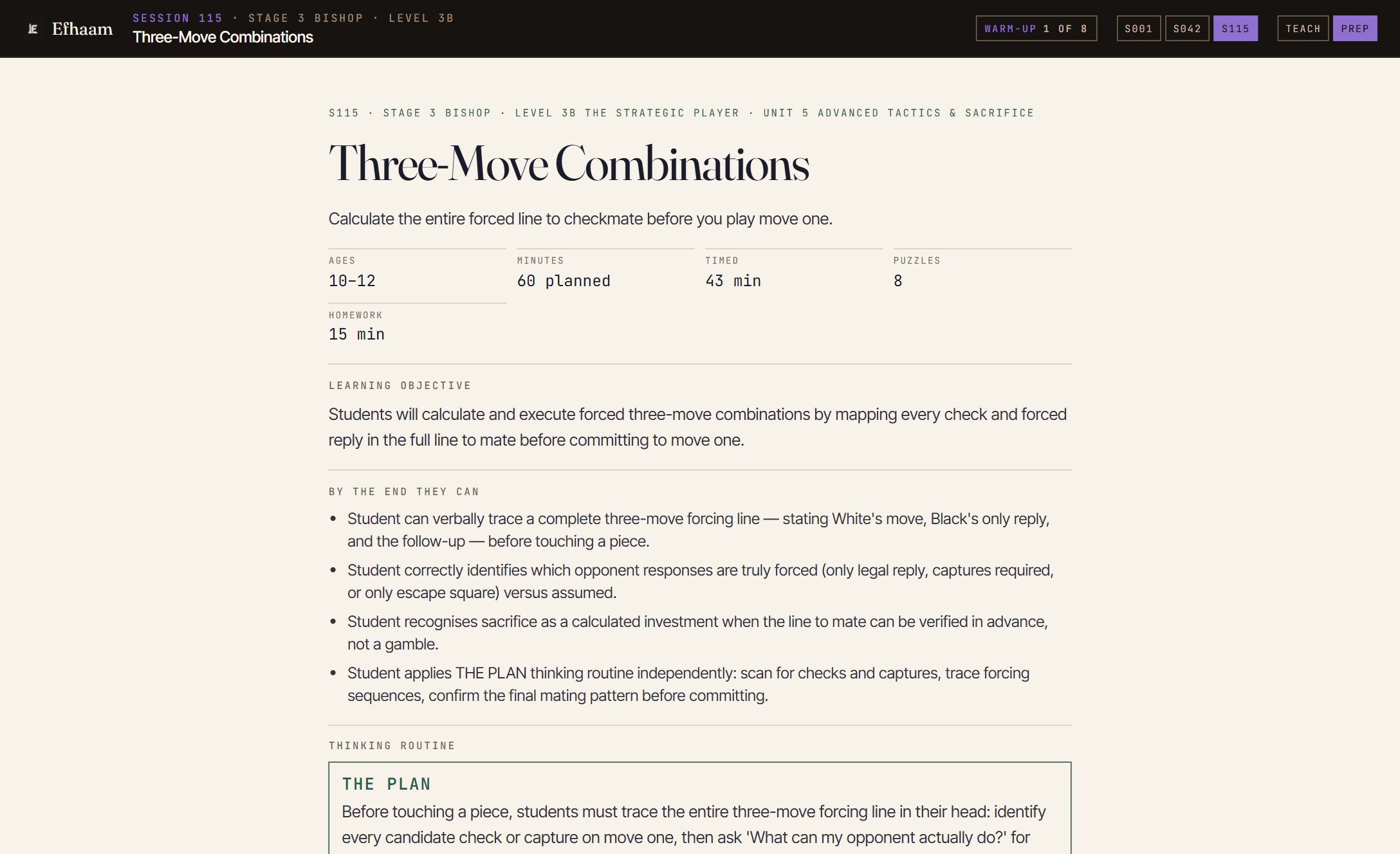
- Learning objective
- By the end they can
- Thinking routine
- Builds on
- Materials
- The eight parts, each in full
- What they wrongly believe
- What they will play
- How to teach it
- If they are stuck
- If they are ahead
- Pacing
- Homework
- Where this comes from
Each session includes notes on common misconceptions, typical mistakes, teaching tips, ways to simplify and extensions for advanced students. These five note types appear in all 213 Explorer sessions.
Thinking routine for this session: THE PLAN. The curriculum introduces five routines across its stages.
A consistent lesson format across 213 Explorer sessions
This sample shows how Teach64 organizes a chess lesson. Browse the curriculum to see session topics, objectives and prerequisites across all five stages.
- 1,701parts in total
- 1,640Explorer positions, graded
- 1,247questions to ask
- 213activities
- 213sessions with homework set
- 1,005stated outcomes